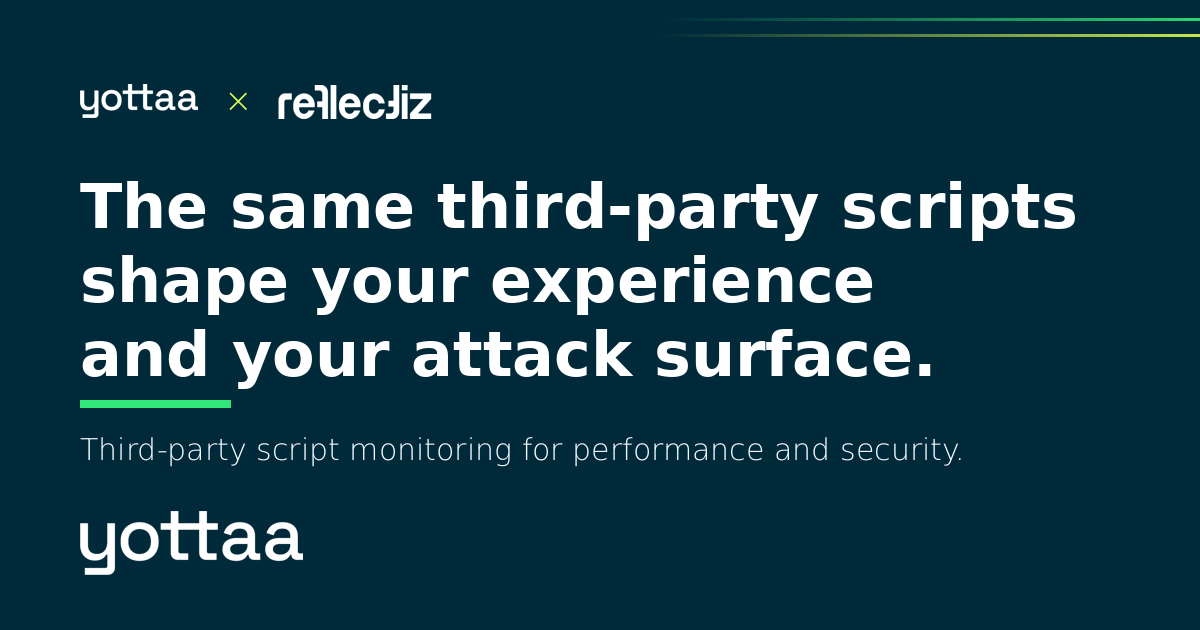



Every modern eCommerce site is an assembly job: a personalization engine, a chat widget, a tag manager, an analytics suite, a consent banner, and the browser stitches them all together at runtime. Each of those vendors adds value, and each one also adds scripts, dependencies, and behavior running inside your shopper’s browser. The catch is that the same code shaping the customer experience is also shaping your web attack surface, and in most organizations those two conversations happen in separate rooms. Security looks at the scripts through a risk lens, digital and performance teams look at the same scripts through a speed-and-conversion lens, and the two rarely compare notes. The result is blind spots on both sides.
We teamed up with our partners at Reflectiz to close that gap. In a new joint article, Yottaa brings the performance and conversion view of every script in the browser, and Reflectiz brings the security and privacy view, on the same set of scripts. Together we make the case that third-party governance isn’t a security problem or a performance problem; it’s both, seen through different eyes. The piece digs into why traditional server-side security tools can’t see browser-side code, why third parties account for roughly 44% of page load time on the average eCommerce site, what PCI DSS 4.0 and privacy regulations now expect, and what a single, shared view of “what’s actually running in our customers’ browsers right now?” looks like in practice.
Subscribe to our blog

Performant Experimentation – A Guide to A/B Testing
Every A/B test you run is a purchase. You’re buying information—an answer to a hypothesis—and you’re paying for it in degraded performance and lost conversion during the test window.
Download eBook