


AI is everywhere in eCommerce right now. Chatbots promise to answer customer questions instantly. LLM-powered search offers more personalized product discovery. And AI-driven personalization tools claim to boost conversion rates across your entire site.
But here’s what’s actually happening: Many retailers are installing these AI tools with high expectations, only to remove them within weeks. The reason? Performance problems that hurt revenue more than the AI tools help.
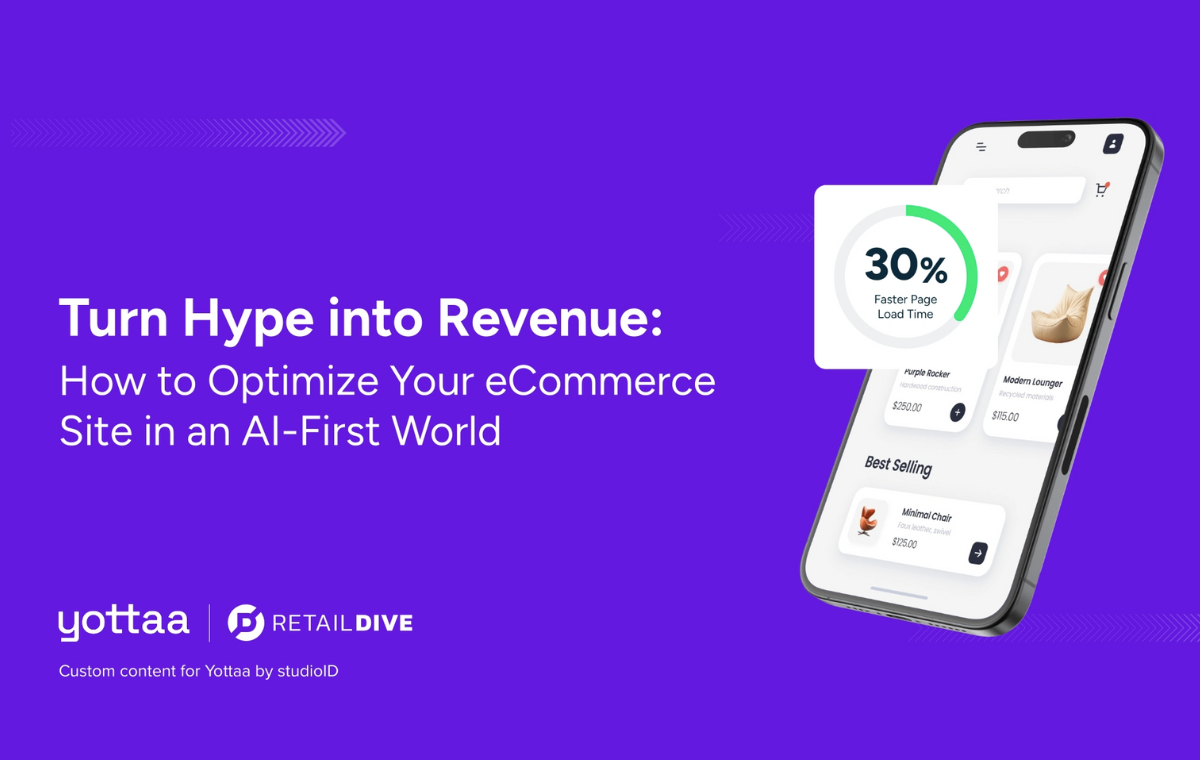
In our recent webinar, “Turn Hype into Revenue: How to Optimize Your eCommerce Site in an AI-First World,” industry experts Darin Archer (Chief Product Officer, Yottaa), Linda Bustos (Founder, Ecom Ideas), and Dom Fee (Product Evangelist, Fastly) tackled this paradox head on. Here’s what they revealed about why AI adoption is failing — and what you can do about it.
The AI Performance Problem Nobody Talks About
AI tools can be slow. There’s no way around it. For eCommerce sites, this creates an immediate problem. Shoppers have gotten used to lightning-fast experiences. The human eye and brain can catch anything over 100 milliseconds, and most people notice delays at around 250 milliseconds. When your AI-powered tools takes several seconds to respond, shoppers notice — and they bounce.
The data backs this up: nearly 65% of shoppers abandon pages that take longer than 4 seconds to load, according to Yottaa’s Web Performance Index.
Why Retailers Are Hitting the Uninstall Button on AI Tools
The stakes are higher than many retailers realize. Saving just 1 second in mobile load time increases conversions by 3% and reduces bounce rates by 8%. When you add an AI tool that increases load time by multiple seconds, you’re not just creating a minor inconvenience — you’re directly impacting revenue.
During the webinar, the experts highlighted three major reasons retailers are removing AI tools shortly after installation:
1. They Take Up Too Much Space
AI chatbots and product Q&A assistants require prominent placement to be effective. But that means they’re competing with product descriptions, reviews, and other high-converting content. 2
2. Customers Don’t Actually Want Them
Here’s a reality check: Only 15% of shoppers prefer chatbots to human interactions. While AI shopping assistants sound great in theory, in practice, many customers find them frustrating, slow, or unhelpful. Web conventions exist for a reason, and sometimes the traditional search bar simply works better.
3. The Performance Impact Is Real
AI tools require significant computational resources. Every query to an LLM costs time and money. Without smart caching strategies and edge optimization, these tools can drag down your entire site. And when you’re losing conversions because of slow load times, the math stops working in AI’s favor quickly.
So How Do You Make AI Tools Work?
The experts agreed: AI isn’t going away, but you need to approach it methodically. Here are the key strategies they recommend:
Start with rigorous A/B testing. Don’t treat AI implementations like lightweight design changes. These are paradigm shifts that require server-side or edge-level testing tools, not just your standard A/B testing platform.
Implement smart caching strategies. Many customer queries are similar, even when phrased differently. As Dom Fee explained, questions like “What is your return policy?” can be cached intelligently so the bot doesn’t need to query the LLM every single time. This speeds up responses and reduces costs.
Structure your data properly. If your catalog structure is messy, your AI tools will struggle. Clean, well-structured data allows LLMs to parse information quickly and deliver better results.
Monitor your KPIs obsessively. Is your new AI tool reducing revenue per visitor? Are bounce rates increasing? Is it actually improving the metrics you care about? If you can’t answer these questions, you’re flying blind.
The Real Opportunity: AI Without the Slowdown
The retailers who succeed in this new era will be those who balance innovation with fundamental web performance principles. They’ll experiment with AI tools while keeping a laser focus on site speed, visual hierarchy, and user experience.
As the webinar panel emphasized, you need to stay ahead of the curve while keeping your majority of customers — the ones who aren’t AI agents — happy with fast, reliable experiences.
Watch the Full Webinar
In the full webinar, you’ll learn:
- How to stay visible to both human shoppers and emerging AI agents
- Strategies for safeguarding against bot-driven abuse and API risks
- Why “Cyborg Monday” could change holiday shopping forever
- The best practices for establishing AI foundations without sacrificing performance
Subscribe to our blog

Performant Experimentation – A Guide to A/B Testing
Every A/B test you run is a purchase. You’re buying information—an answer to a hypothesis—and you’re paying for it in degraded performance and lost conversion during the test window.
Download eBook