
You’ve paused all your A/B tests. Your dashboard shows zero active experiments. So your site performance should be in the clear, right?
Not quite. Here’s what most eCommerce teams don’t realize: even with every test paused, your A/B testing platform is still loading on your site, still checking its server for active experiments, and still hiding content from shoppers. The result? Slower load times, worse Core Web Vitals, and lower conversion rates — even when you’re not testing anything.
According to the 2025 Yottaa Web Performance Index, 63% of shoppers bounce from sites that take over 4 seconds to load. Third-party tech drives 44% of total load time, and A/B testing platforms fall squarely in that category.
The Hidden Performance Tax
Client-side A/B testing platforms need to show users different versions of your site without letting them see the original page flash before the variant loads. To prevent this flashing, these platforms place a “page-hiding snippet” over your site. Think of it as a white curtain that covers your page while determining which experience to show.
Even when you have no active tests running, that curtain still drops. As Shawn O’Neill, VP of Performance Consulting at Yottaa, explains: “Even when no experiments are running, the A/B testing system is still loading on the site. It’s going back to its server to determine if any experiments are running and still hiding the page.”
This delay impacts Core Web Vitals and drives up bounce rates. Every millisecond counts, and your paused testing platform is costing you conversions.
The Shocking Case Study on A/B Testing Platforms
One Yottaa customer ran an experiment most brands never consider: an A/B test of their A/B testing program itself. They’d accumulated multiple “winning” tests, each running at 100% traffic and delivering 2-3% conversion lifts. These gains should have compounded into significant revenue growth.
But when they turned off the A/B testing platform entirely, something unexpected happened. The baseline with no testing platform outperformed all those accumulated wins combined. The performance tax from running the platform — even with all experiments set to 100% — was eating away more conversion than the optimizations were adding.
This reveals a crucial truth: performance impacts conversion just as much as your experiments do.
Want to hear more about this case study? Watch the full conversation between Linda Bustos and Shawn O’Neill about A/B testing and performance.
The Zombie Script Problem
Here’s the really concerning part. According to the Web Performance Index, 10% of eCommerce sites with A/B testing tools are still loading Google Optimize — even though Google decommissioned the service years ago. More than 1 in 10 sites is loading a render-blocking script that serves absolutely no purpose.
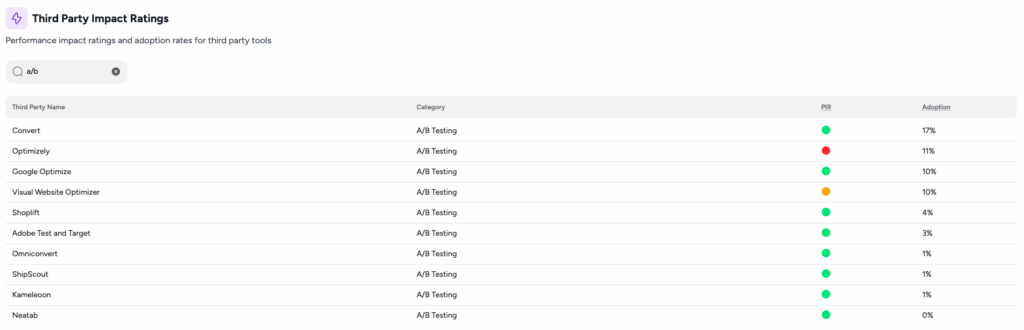
Performance data as of November 10, 2025
The landscape as of November 10, 2025, shows Convert leading adoption at 17%, followed by Optimizely at 11%, and Google Optimize still clinging to 10% despite being defunct. Visual Website Optimizer holds another 10%, with smaller players like Shoplift (4%), Adobe Test and Target (3%), and others making up the remainder.
This points to a systemic issue with third-party script governance. Teams add testing tools, win tests, and implement changes, but then never remove the underlying platform. Technical debt accumulates silently, taxing performance and costing conversions with every page load.
Getting Performance-Ready
As eCommerce expert Linda Bustos puts it, “Brands need to experiment in the regular season and then show up ready for the playoffs.” Here’s how to get performance-ready for your busiest periods.
Bake winners into your base templates.
Once a test wins conclusively, hardcode the winning variant directly into your site instead of leaving it running in your testing platform. This eliminates the performance overhead entirely.
Use feature flags to completely disable testing platforms.
Don’t just pause individual tests. As O’Neill explains, “Wrap the feature flag around your A/B testing snippet and disable it from that level, not just let it continue to load.”
Audit your third-party scripts regularly.
Check for zombie scripts like Google Optimize. Look at what’s actually loading on your site, not just what you think should be there.
Consider server-side testing.
For brands that need ongoing experimentation, server-side testing eliminates the page-hiding snippet issues that plague client-side platforms.
Performance Is Conversion Optimization
Revenue teams often overlook the biggest conversion lever: site speed. Performance is a conversion optimization initiative that deserves the same strategic attention as your experimentation roadmap.
As O’Neill notes, “Thinking about performance as important as or as impactful on conversion as your CRO program, and then using CRO very strategically, surgically, can be a really big win.”
Use A/B testing when you need it — for high-stakes decisions or major UX changes. But when you’re not actively experimenting, turn it off completely. Performance becomes your always-on conversion optimization tool, reducing bounce rates across every page and lifting conversion throughout the funnel.
Take Action on A/B Testing Today
As you prepare for peak traffic periods, audit your A/B testing setup. Ask yourself: Are we actually running tests right now? If not, is the platform still loading? Could we be losing more conversions to performance lag than we’re gaining from past experiment wins?
The irony is clear: we run these tests because being data-driven is the right thing to do. We chase tiny incremental gains. Meanwhile, we’re not thinking about how the testing infrastructure itself impacts site speed, bounce rate, and conversion.
Performance and conversion optimization aren’t separate disciplines. They’re two sides of the same coin. The brands that treat performance as a revenue lever and not just a technical requirement are the ones that show up ready when conversion matters most.

