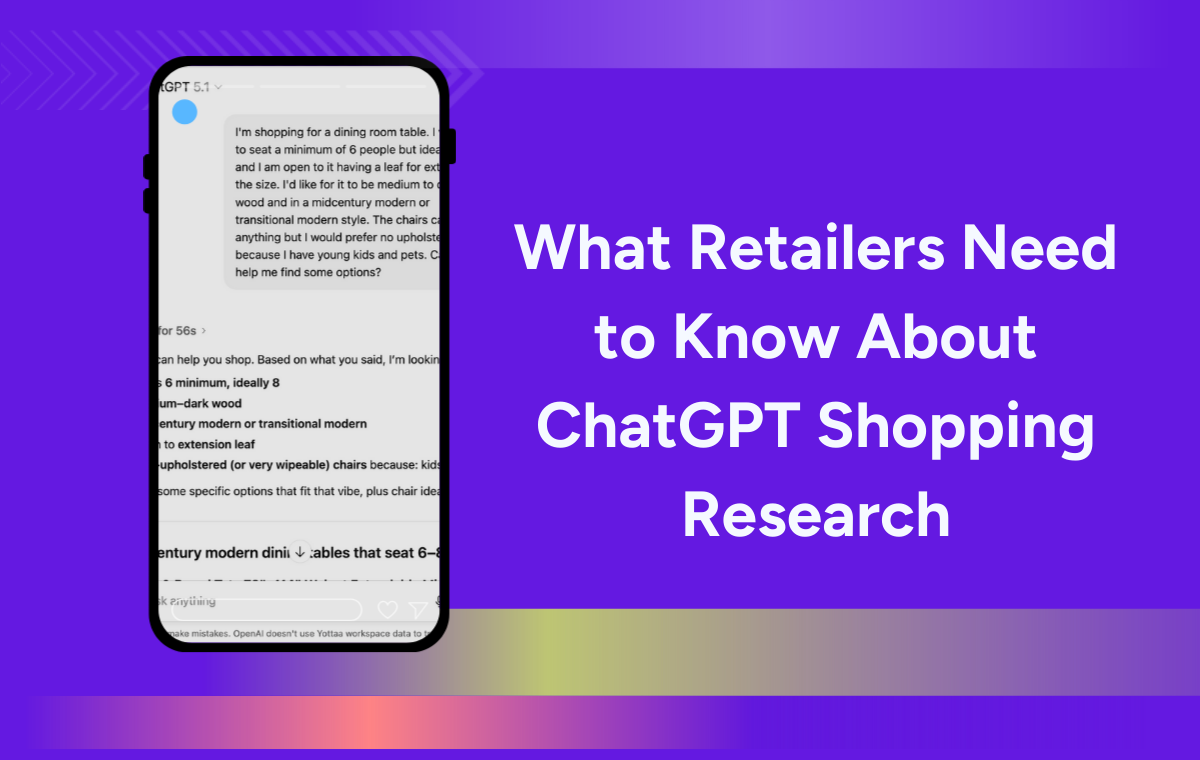
OpenAI’s new Shopping Research feature in ChatGPT is more than a holiday gimmick. It turns ChatGPT into a personal shopping assistant that can ask clarifying questions, scan trusted sources across the web, and return curated buyer guides for complex purchases.
Instead of juggling multiple browser tabs, shoppers describe what they need in natural language — like, “find a compact stroller that folds easily and fits in a small trunk” or “compare three laptops under $1,200 for photo editing.” Then ChatGPT comes back with options, tradeoffs, and shortlists.
For retailers, that means a growing share of shoppers will arrive on your site after ChatGPT has already done the heavy lifting of research and comparison. Those visitors are more informed, more opinionated, and closer to a decision. The opportunity is real, but so is the risk if your site is slow or confusing — or worse, not discoverable by AI at all.
What ChatGPT Shopping Research Actually Does
OpenAI positions Shopping Research as an option for detail-heavy categories like electronics, beauty, home and garden, kitchen appliances, and sports or outdoor gear. It is built to handle multi-constraint queries where shoppers care about budget, specs, and tradeoffs at the same time.
A typical flow looks like this:
- The shopper asks a question.
- ChatGPT responds with a short quiz to refine preferences (budget, size, use case).
- Behind the scenes, it crawls a wide set of sources, reads reviews, and organizes options into a buyer’s guide with pros and cons.
- The user can say “more like this” or “not interested,” and the guide updates.
Shopping Research is designed for complex, considered purchases, not for quick price checks. Quick questions still go through the normal ChatGPT flow; Shopping Research is explicitly opt-in for deeper research sessions.
Why This Is a Big Deal for Retailers
The launch matters less as a feature announcement and more as a signal: AI is becoming the first layer of shopping research. That has a few implications.
AI results are not just a mirror of Google.
Your GEO guidance already highlights that only a small share of ChatGPT answers overlap with traditional Google results. In one study, there was a 62% overlap between Google rankings and ChatGPT answers.
For retailers, that means:
- Ranking well on Google does not guarantee you are prominent in AI-generated buyer guides.
- Content that is readable, structured, and up to date becomes more important, because LLMs need to parse and repurpose it reliably.
Queries are longer and more specific.
Generative AI queries tend to be full sentences with multiple conditions, not shorter keyword strings.
This shift matters because:
- Product content must answer real shopper questions directly, not just target keywords.
- Pages with clear structure, scannable details, and straightforward explanations are easier for AI systems to interpret and surface.
- AI engines favor content that provides helpful, complete context — not thin descriptions optimized only for search.
AI-referred visitors arrive further down the funnel.
According to Yottaa data tracked over the 2025 Cyber 5 holiday weekend, AI services referred a whopping 77% of users to product detail pages (PDPs) over category or home pages, compared to only about 60% of Google Search queries.
By the time they land on your site, many already have guardrails in mind — expected price ranges, must-have features, and a short list of acceptable brands. In some cases, AI has already helped them rule out competitors. They arrive closer to checkout, with fewer open questions and less patience for friction. Which is why the moment they hit your PDP or cart flow becomes the defining factor in whether the visit converts or disappears.
How Retailers Can Prepare for AI-Driven Shopping
With AI shaping more of the research process, the question for retailers becomes simple: how do you make sure you’re ready for the shoppers ChatGPT is sending your way?
1. Make content LLM-friendly.
You don’t need to overhaul your entire site for AI, but your content does need to be clear enough for both shoppers and language models to interpret. Prioritize straightforward structure and plain language. Use descriptive headings, answer common buyer questions directly on the page, and keep paragraphs tight and readable. Updating high-value pages regularly also helps ensure they reflect accurate, current information.
A useful rule of thumb: if a human support agent would struggle to explain your PDP copy, an LLM will too.
2. Prioritize speed on the pages AI shoppers actually hit.
ChatGPT referrals tend to land on pages where intent is already high. These are the moments where delays or instability do the most damage. Focus on fundamentals: fast initial loads, minimal layout shift, and disciplined use of third-party scripts for reviews, personalization, and chat. When these pages feel fast and predictable, shoppers stay engaged and move forward.
3. Watch for AI-driven traffic anomalies.
As Shopping Research adoption grows, patterns may shift abruptly. Certain SKUs or categories might see unexpected spikes, or conversion rates may change on pages mentioned in buyer guides. Keep an eye on these fluctuations, especially during major retail moments. Teams that monitor performance closely and adjust quickly are better positioned to capture demand.
4. Clean up your tech stack.
AI-referred visitors magnify the impact of unnecessary complexity. Redundant tags and scripts slow down shoppers who are already close to a decision. Overly aggressive personalization can add weight without adding clarity. Legacy integrations often introduce friction at the worst possible time. Use this moment as a reason to reassess what truly needs to load on your key templates and what can be removed, deferred, or streamlined.
The Retailers Who Win Will Treat AI as a Channel, Not a Toy
OpenAI is not turning ChatGPT into a full-blown marketplace overnight, but the direction is clear. Shoppers will increasingly start their journey in AI tools, not in a search bar, and they will land on your site with fewer questions and higher expectations.
The ChatGPT Shopping Research feature compresses the early stages of discovery, meaning visitors show up with clearer intent and higher expectations. Retailers that keep their content clear, their pages fast, and their tech stack disciplined will be ready for this shift. Those that don’t will feel the impact quickly.