



On October 1, Shopify stopped letting apps create or update script tags on storefronts. The block applies to every API version, so pinning an older one doesn’t help. Existing script tags keep running until March 1, 2027. On that date Shopify stops injecting them, and anything that still depends on one stops working.
Don’t confuse this with Shopify Scripts, the checkout customization tool retired in June. Script tags are the older mechanism apps use to drop JavaScript onto your storefront without touching theme code.
Shopify’s reasoning is the interesting part. Its developer changelog says script tags “run JavaScript directly on a storefront without appearing in the theme editor, which makes them difficult for merchants to find and control.” That is the platform describing, in its own words, the problem performance teams have lived with for years: code running on your revenue pages that nobody on the team can see.
What changes for merchants
Apps get two replacements. Scripts that power features move into app embed blocks, which ship inside a theme app extension and appear in the theme editor with an on/off switch. Scripts that only collect analytics or conversion data move to web pixels, which run in a sandbox.
That’s real progress. You’ll see most app code listed in one place. But a switch tells you an app is on. It doesn’t tell you what the app costs.
Why the timing is awkward
The migration window runs from October 1 to March 1. Black Friday and Cyber Monday sit in the middle of it. Shopify’s own migration guide names three risks worth reading twice.
Scripts can load twice. Until March 1, “a script tag and its replacement running at the same time will load your script twice, which can double-count analytics events or render your app’s UI twice.” A duplicate script adds main-thread work on every page it touches, and double-counted events quietly distort the numbers you’ll use to judge peak.
App embeds are per theme. An app embed block “is only active on the theme it was enabled on.” Publish a holiday theme and every migrated app has to be switched on again there. Miss one and the feature disappears without an error.
Some scripts move into theme code. Apps created directly in the Shopify admin can’t use app extensions. Shopify’s guidance is to move those scripts into the theme, and it notes that a script in theme code “stays there after the app is gone.” That’s the same orphaned-code problem merchants keep describing in Shopify Community threads, now with an official path to more of it.
One more detail: an earlier version of the plan warned merchants when they installed an app that still used script tags. Shopify has decided not to show that banner for now. The alerting is on you.
Why this is a performance story
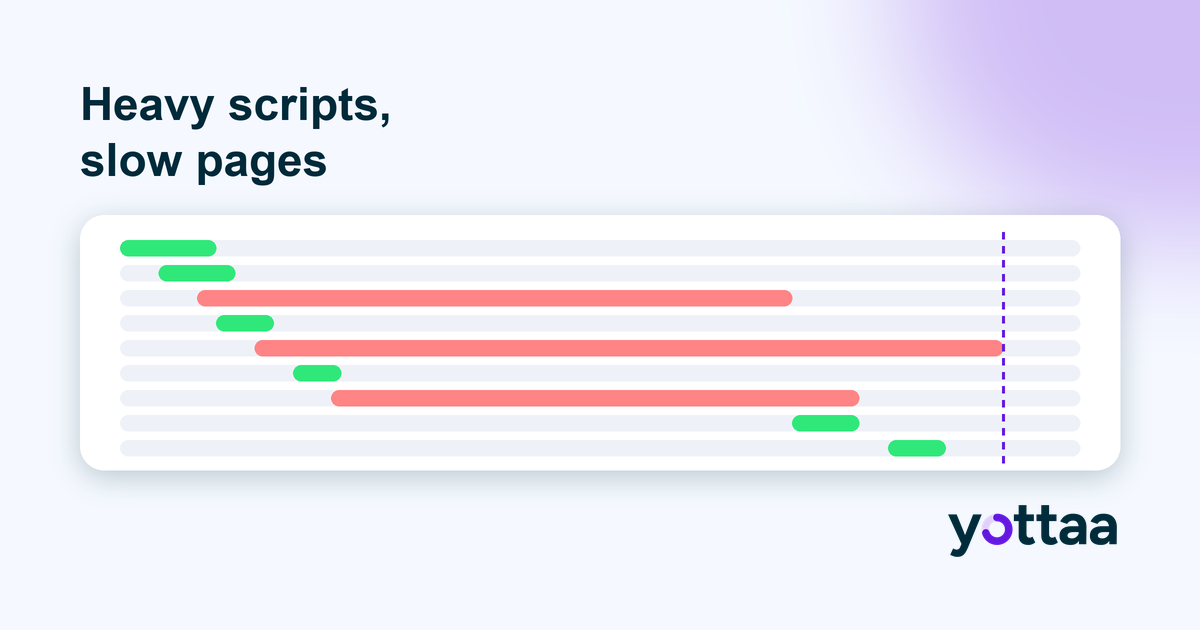
Third-party apps account for 44% of eCommerce load time and about 70% of performance problems on Shopify stores, according to Yottaa. Moving that code from one delivery method to another doesn’t make it lighter. A migrated app can load earlier, later or more often than before, and the change lands on product and cart pages, where apps concentrate.
Responsiveness is where it shows. Shopify’s April 2026 analysis found that every 32 milliseconds of slower interaction response is associated with about 1.5% lower conversion. A widget that now loads twice adds work to exactly the taps and clicks that number measures.
What to do this month
- Inventory what runs today. List every third-party script on your storefront and the app that owns it. Ask each vendor whether they still use script tags.
- Get migration dates in writing. You want replacements live before your peak change window, not during it.
- Check activation on every theme you’ll publish, including holiday and campaign themes.
- Hunt for doubles. After each migration, confirm the old script tag is gone and the new embed loads once.
- Measure in field data. Compare product and cart pages before and after each switch, on real phones, not only in a lab test.
This is the gap Yottaa’s Rapid platform is built for. It detects and catalogs the third-party tags on your site and continuously monitors them for changes, so an app that changes how it loads shows up as a visible change instead of a mystery dip. Application Sequencing then controls when each third party loads, whether it arrives through a tag manager or your site’s own source.
The bigger shift
Shopify is right that merchants should be able to see what runs on their storefront. By March, the theme editor will show which apps are on. The better question for every eCommerce team is what each of those apps costs, on which pages, for which shoppers.
How many of your storefront apps could you name today, along with what each one costs your product page?
Subscribe to our blog

Performant Experimentation – A Guide to A/B Testing
Every A/B test you run is a purchase. You’re buying information—an answer to a hypothesis—and you’re paying for it in degraded performance and lost conversion during the test window.
Download eBook