


On October 6 and 7, Amazon’s Prime Big Deal Days drove $9.86 billion in U.S. online spending, according to Adobe, up 8.5% from last year’s event. Target and Walmart ran competing sales. Mobile accounted for 52% of online sales, or $5.1 billion, up 12.8% year over year. Discounts peaked at 20% off list price.
Adobe said the event “has changed the shape of the holiday shopping season.” Numerator’s data says it more bluntly: more than a third of shoppers completed at least half of their holiday shopping during the event, and intent to shop Black Friday and Cyber Monday fell 4 and 5 points from last year.
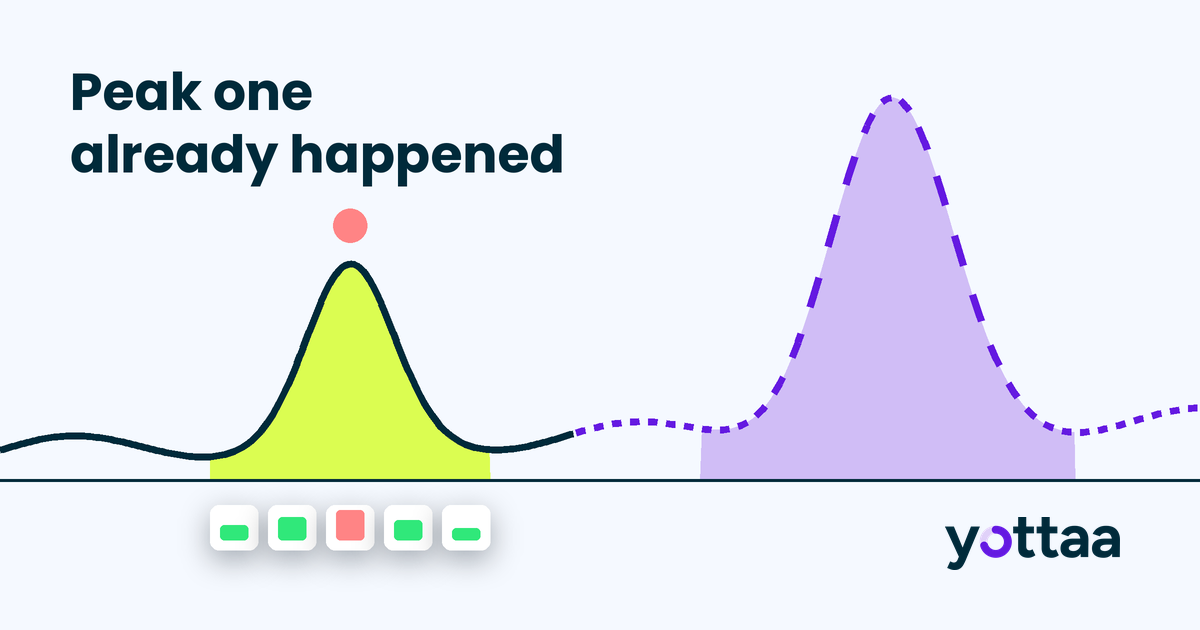
A week later, the National Retail Federation forecast November and December retail sales at $1.013 trillion, up 4.2%, compared with 3.1% growth last year. The second peak still matters. The first one already happened.
The first peak was real
Most peak plans still treat Cyber 5 as the event and October as a warm-up. The October numbers say otherwise. Shoppers spent real money, mostly on phones, under heavy promotion, and a meaningful share of them are now done.
That raises the stakes on November rather than lowering them. If some demand moved earlier, the shoppers left for Black Friday are the ones you need to convert. Shopify’s April 2026 analysis puts the cost of every 100 milliseconds of load time at 3.5% of conversion rate. That math applies on November 27 as much as on any other day.
It was also the best load test you’ll get
Synthetic load tests and pre-peak audits run against a quiet site. October 6 and 7 ran on the real one: promo banners, deal countdowns, buy now, pay later messaging, a surge of mobile traffic, and whatever scripts marketing added for the sale. In Yottaa’s data, third-party apps already account for 44% of eCommerce load time. Event weeks are when that share tends to grow.
If you collected real-user data on those days, you have a recording of your site under conditions close to Black Friday. Most teams haven’t opened it. The event went fine, revenue came in, and attention moved on to the November plan.
What to pull from the recording
Four questions, in order:
- Did event-day pages get slower than a normal week? Compare October 6-7 with a baseline week, by template and device. Start with mobile product and cart pages, since mobile carried more than half of sales.
- What was added for the event? List every script, widget and app that went live for the sale. Check whether each is still running and what it cost on the pages it touched.
- Where did conversion fall off? Bucket event-day sessions by load time and compare conversion rate across buckets. If the slowest bucket grew during the event, that’s where a fix pays back.
- Who was actually shopping? Sales events draw price scrapers and bots. Take them out before you compare conversion rates, or the comparison is noise.
No real-user monitoring on those days? Google’s Chrome UX Report still holds a coarse version. Its rolling 28-day window will include October 6 and 7 until early November, at origin level and for higher-traffic URLs, with no session or script detail. It won’t tell you which widget caused a slowdown, but it will show whether mobile got worse.
Then fix the two or three things the data points to and ship before November. Because the Chrome UX Report averages over 28 days, a fix that ships by about October 30 is fully reflected in that data by Black Friday. Your shoppers feel it the day it ships.
Where Yottaa fits
This is the work Yottaa is built for. Yottaa RUM records real sessions across browser, edge and origin, including the 15% to 30% of traffic browser-only monitoring misses, and separates shoppers from bots. Conversion Insights shows how load time maps to conversion rate on your own site. And Application Sequencing controls when event scripts load without a code change, which helps when engineering time in November is already spoken for.
Five weeks to the second peak
Black Friday is November 27 and Cyber Monday is November 30. The teams in the best position won’t have the biggest plans. They’ll have read October’s data and changed something because of it.
What did your field data show for October 6 and 7?
Subscribe to our blog

Performant Experimentation – A Guide to A/B Testing
Every A/B test you run is a purchase. You’re buying information—an answer to a hypothesis—and you’re paying for it in degraded performance and lost conversion during the test window.
Download eBook